


What is in anAML/CTF Program?
An AML/CTF Program is a mandatory written document that sets out how an Australian reporting entity meets its compliance obligations under the AML/CTF Act 2006. While the fundamental structure is standardised, the law requires that the program be tailored to the nature, size, and complexity of the specific business.
Framework and Governance
The AML/CTF Program is your firm’s defence for demonstrating reasonable efforts have been made to meet AML/CTF regulatory requirements. If the AML/CTF Program is weak in crucial aspects, regulatory risk increases.
Avoid making the mistake of establishing a policy yet fail to implement policy requirements.
– Approval and Oversight: The program must be approved and overseen by the Board and senior management.
– AML/CTF Compliance Officer: A designated individual responsible for the implementation and ongoing management of the program.
– Employee Due Diligence (EDD): Procedures to screen prospective and existing employees to prevent “insider threats”.
– Staff Training: Initial and ongoing training to ensure staff can identify emerging threats and understand their reporting obligations. Training must be tailored to the specific red flags relevant to the entity’s products (e.g., a bullion dealer’s staff must know how to spot gold-related layering, whereas a remitter’s staff must focus on “cuckoo smurfing” or “structuring”.
Risk Mitigation and Ongoing Risk Analysis and Reporting
The ML/FT Enterprise-Wide Risk Assessment (EWRA) is regarded as the foundation of the program. The EWRA must identify, assess, and understand risks across four key areas: Customers, Products/Services, Delivery Channels, and Foreign Jurisdictions.
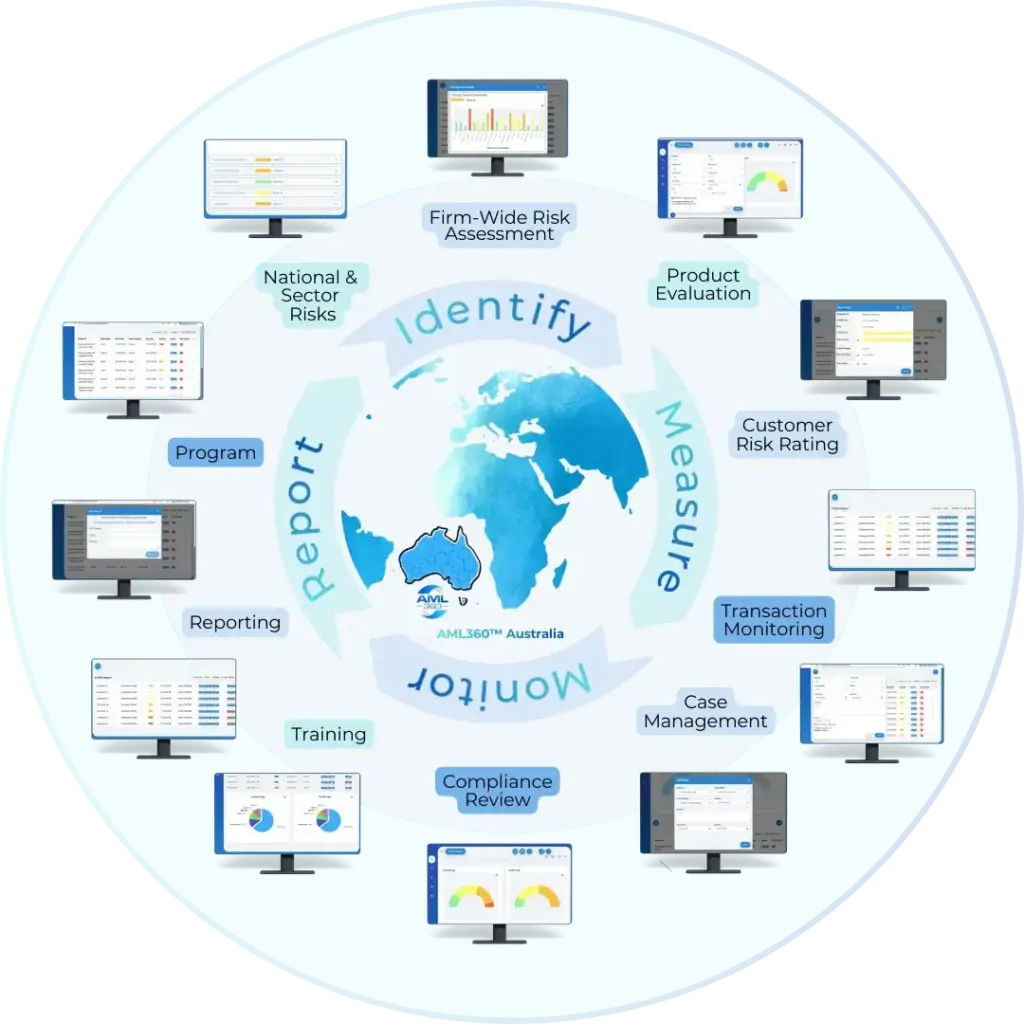
AML/CTF Program: Ongoing Monitoring
Whilst the onboarding process identifies and verifies the customer is who they say they are, ongoing monitoring ensure the customer’s account activity is expected and not unusual..
Ongoing monitoring refers to ensuring your firm has checks and balances in place to identify when the client activity may be undertaking activity that seems suspicious or unusual.
– Transaction Monitoring Program (TMP): Risk-based systems and controls to identify transactions that are inconsistent with a customer’s profile or indicate suspicious activity.
– Automated Reporting: AML360™ provides customised and automated rules and detection parameters. With a customised approach to AML/CTF compliance, your business can demonstrate compliance reporting is aligned to the nature, size and complexity of your business.
– Independent Review: Your firm should set a frequency for engaging an independent audit. The independent review will assess the effectiveness and relevance of the controls as established in the AML/CTF Program.
AML/CTF Program: Customer Identification and Verification
– Applicable Customer Identification Procedures: Standard procedures for collecting and verifying identity information, typically using driver’s licenses, passports, or electronic verification.
– Beneficial Ownership: Identifying the individual(s) who own 25% or more of, or otherwise control, a business customer.
– Politically Exposed Persons (PEPs) and Sanctions: Policies for checking customers against official watch lists and commercial databases
– Enhanced Customer Due Diligence (ECDD): Triggers for additional investigation, such as clarifying the source of funds and source of wealth for high-risk customers.
– Entities must define ECDD Triggers specific to their business. A remitter might trigger ECDD for any transaction over a certain threshold to a high-risk jurisdiction, while a mutual bank might trigger it based on “unexplained wealth” inconsistent with a customer’s known employment
AML/CTF Program: Reporting Obligations
– Suspicious Matter Reports (SMRs): Identifying and reporting suspicious activity to AUSTRAC.
– Threshold Transaction Reports (TTRs): Reporting transfers of physical or digital currency of $10,000 or more.
– International Funds Transfer Instructions (IFTIs): Capturing instructions to transfer funds into or out of Australia.
– The Volume and Nature of Reporting will vary. Independent remitters often submit thousands of IFTIs but few SMRs, whereas major banks submit the vast majority of all SMRs due to their central role in the payment ecosystem.
– AML/CTF Compliance Reports: Annual reports submitted to AUSTRAC detailing how the entity has met its obligations.
Keep in touch with AUSTRAC Reforms.