

What 'Maintaining' an AML/CTF Program Really Involves
An AML/CTF Program does not fail because people don’t care—they fail because manual processes don’t scale. As AML/CTF requirements expand (and scrutiny intensifies), many organisations discover that an AML/CTF Compliance Program built on spreadsheets, shared drives, and email approvals becomes hard to maintain, hard to evidence, and even harder to improve over time. Learn how RegTech practically helps maintain an AML/CTF compliance framework, anchored around the day-to-day realities of an AML/CTF Program.
Maintaining an AML/CTF Program isn’t just writing a policy and filing it away. It typically means keeping multiple moving parts current, consistent, and provable, including:
-
Governance
The AML/CTF Program must establish ownership, approvals, reporting lines and oversight of monitoring and reporting.
-
Risk Management
Methods of how business-wide and product/channel/customer risks are measured and reported must be in place.
-
Controls
Policies, procedures and controls within the AML/CTF Program must incorporate effective management of customer due diligence (CDD), transaction monitoring, screening, and reporting. This includes triggers and risk thresholds.
🔍 How regulatory technology helps maintain an AML/CTF Program
A common maintenance problem of an AML/CTF Program is fragmentation: policies in one folder, risk assessments in another, training logs in HR systems, and evidence scattered across employee emails and desktops.
1) AML360™ Centralises the AML/CTF Program so it stays “one version of truth”
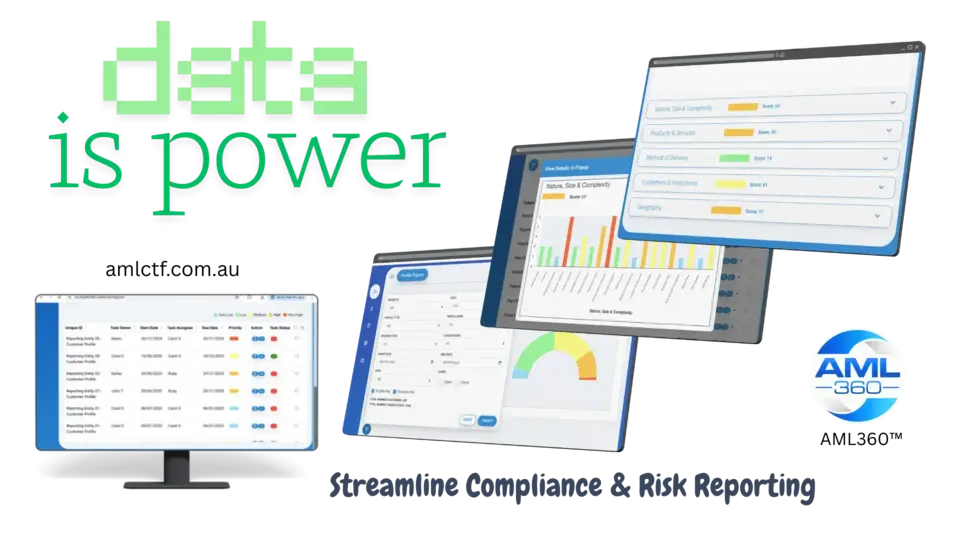
The AML360™ Dashboard operates from a keyboard with a simple user-interface. The complexities are pre-configured so users simply select data on screen, add any additional detail, then submit to receive AML/CTF compliance reporting, structured to risk-based measures.
By centralising policies, procedures and controls of an AML/CTF Compliance Program into a keyboard component, your business can easily control its ML/TF compliance program.
A digital AML/CTF framework reduces duplication of documents and conflicting versions. This creates a clearer link between policy → procedure → control → evidence-based compliance.
Streamlining and using automated data processes make ongoing compliance less dependent on individual memory and more dependent on reliable systems that have ongoing oversight.
2) Builds repeatable workflows for reviews, approvals, and changes
AML/CTF compliance is full of recurring events: annual reviews, periodic control testing, policy updates after a change in services, and management reporting.
RegTech supports maintenance by: (a) Automating review cycles with reminders and task assignment, (b) Capturing approvals with timestamps and accountable owners, (c) Keeping a record of what changed, why it changed, and who signed off.
This keeps your AML/CTF Compliance Program current—and makes it far easier to demonstrate governance during audits or regulatory engagement.
3) Strengthens evidence and auditability (the “show me” problem)
In practice, compliance often comes down to evidence:- can you prove the control operated, that an exception was handled correctly, and that issues were remediated?
AML360™ RegTech helps by (a) creating audit trails for key decisions and actions, (b) streamlining reports, reviews, case notes and management reporting, (c) standardising record keeping so evidence of the ML/TF compliance framework are consistent and retrievable.
A well-run AML/CTF Compliance Program is as much about evidencing control effectiveness as it is about having policies.
4) Improves consistency in risk and control management
Inconsistent risk ratings, ad-hoc control descriptions, and “tribal knowledge” create gaps that regulators tend to notice.
RegTech supports a maintainable AML/CTF Program by: (a) Standardising risk libraries and controls; (b) Enforcing required fields (rationales, ratings; owners, review dates); (c) Making it easier to compare risks across products, channels, or business units.
This consistency is what turns compliance from subjective judgment into defensible reasoning. Objectionable reasoning is often referred to as risk-based or principles-based outcomes.
5) Makes ML/TF management measurable and harder to ignore
Every AML/CTF function discovers gaps—what matters is how quickly they’re identified, escalated, and fixed.
RegTech strengthens maintenance by: (a) Logging issues, incidents, and findings in a structured register; (b) Assigning remediation owners and deadlines; (c) Tracking status, blockers, and closure evidence; (d) Providing management reporting on trends and repeat issues.
That “closed loop” approach is a hallmark of a mature AML/CTF Program.
6) Enables better compliance reporting without reinventing the wheel
Manual reporting often becomes a monthly or quarterly scramble—copying figures, rewriting narratives, and chasing updates from different teams.
RegTech helps by: (a) Pulling reporting from live program data (risks, controls, issues, training); (b) Producing consistent dashboards and board packs; (c) Showing movements over time (new risks, control changes, remediation progress).
In other words, ML/TF RegTech turns an AML/CTF Compliance Program into an output of operations to evidence reasoning and compliance obligations.

Learn AUSTRAC expectations of ML/TF RegTech