
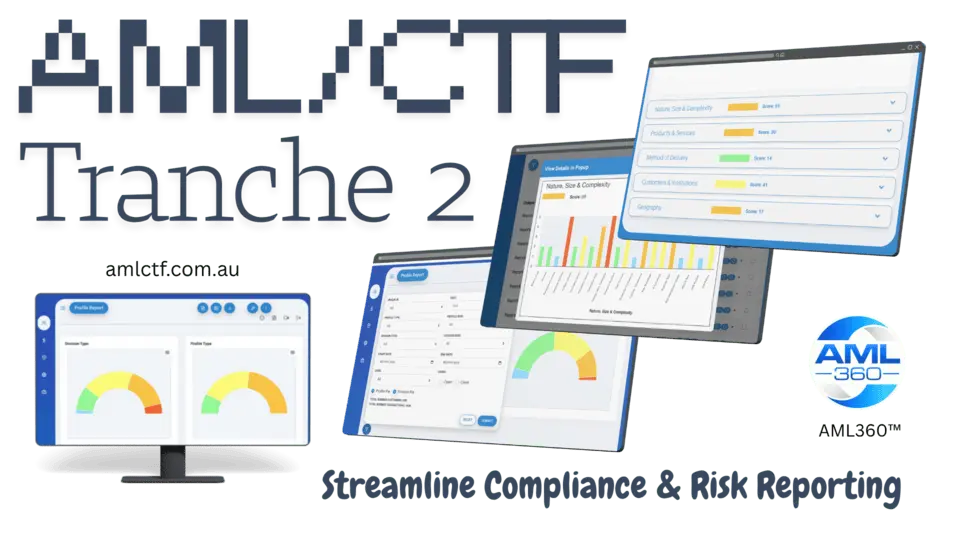
AML/CTF Australia - Get Regulatory Technology forAML/CTF Programs
AML/CTF Tranche 2: Regulatory Technology (RegTech) is becoming a practical advantage for managing AML/CTF compliance under Australia’s Anti‑Money Laundering and Counter‑Terrorism Financing Act 2006 (AML/CTF Act). As Australia’s single AML/CTF regulator (AUSTRAC) continues to sharpen a more risk‑based approach to supervision and enforcement, businesses must sharpen their AML/CTF Program.
AML/CTF Tranche 2: Why This Expansion Is a Business Inflection Point
AML/CTF Regulatory Technology (RegTech) becomes a genuine competitive lever. Done well, RegTech helps smaller and mid-sized businesses meet industry-grade AML/CTF standards without drowning in manual administration, duplicated effort, or endless spreadsheet gymnastics. Solutions like AML360™ Reg Tech are built to help organisations customise and streamline a regulatory risk-based reporting framework to align with AML/CTF regulations—while prioritising what newly captured Tranche 2 businesses need most: seamless integration, less friction, and the elimination of repetitive human resourcing actions.
Compliance under Tranche 2 is continuous, not occasional
For newly captured entities, it can be tempting to treat AML/CTF as a “project”: create a policy, hold a training session, file it away, and hope that’s sufficient. But Tranche 2 expectations push businesses toward ongoing activities such as:
⇢ Maintaining a current understanding of money laundering and terrorism financing (ML/TF) risk exposure
⇢ Applying controls proportionate to that exposure (the risk-based approach)
⇢ Keeping accurate records and producing evidence on demand
⇢ Demonstrating governance and oversight, not just intent
In plain terms: Tranche 2 creates an environment where you need to show your work—consistently.
The “level playing field” is real—RegTech cuts costs for AML/CTF Tranche 2 entities
When regulators and counterparties evaluate AML/CTF maturity, they often care less about your company size and more about your control quality, consistency, and auditability. That can feel intimidating for small businesses, because large institutions have teams, budgets, and legacy tooling.
But Tranche 2 also creates opportunity. Businesses that adopt the right systems early can leapfrog older, more manual approaches and operate with a level of sophistication that earns trust faster—especially with banks, payment providers, and enterprise customers.
The Practical Problem: Manual AML/CTF Doesn’t Scale (and Tranche 2 Exposes It)
Most newly captured businesses already have operational processes for onboarding customers, delivering services, and managing payments. The friction appears when AML/CTF obligations are layered on top with manual steps, disconnected tools, and unclear accountability.
Common pain points when businesses move into AML/CTF Tranche 2
The most frequent operational issues look like this:
⇢ Repeated data entry across CRM, onboarding tools, spreadsheets, and compliance folders
⇢ Inconsistent risk decisions because rules live in people’s heads rather than in workflows
⇢ Evidence gaps where the business did the right thing but can’t prove it cleanly
⇢ Approval bottlenecks (and email chains) that slow down customer onboarding.
⇢ Last-minute reporting scrambles that drain leadership attention
When compliance depends on heroic effort, it becomes fragile. Growth then turns fragility into risk.
The hidden cost: human resourcing gets consumed by repetitive actions
One of the most expensive compliance “traps” is using people as the integration layer—asking staff to copy, paste, reconcile, and reformat information repeatedly.
Under Tranche 2, this pattern can show up as:
⇢ Rebuilding the same reporting pack every month or quarter
⇢ Chasing the same documents from the same teams repeatedly
⇢ Re-checking the same customer information across systems
⇢ Manually tracking review cycles, exceptions, and escalations
This isn’t just inefficient. It creates inconsistency—and inconsistency is where compliance risk grows.
Why AML/CTF RegTech Is a Game-Changer for Tranche 2 Businesses
AML/CTF RegTech is often described in terms of speed and automation, but its true value is more strategic: it turns compliance into a repeatable operating capability.
A good RegTech foundation helps you build a system where risk decisions are consistent, reporting is structured, and evidence is captured as part of the workflow—not reconstructed after the fact.
Less friction: compliance that doesn’t fight your customer experience
Newly captured Tranche 2 businesses often worry that compliance will slow down onboarding and frustrate customers. That risk is real—when compliance is bolted on manually.
RegTech reduces friction by:
⇢ Embedding checks into operational workflows
⇢ Structuring approvals so decisions move forward predictably
⇢ Making reviews and escalations clear, timed, and trackable
⇢ Reducing “start over” moments caused by missing information
The practical payoff: smoother operations and fewer customer drop-offs.
Seamless integration: stop the “swivel-chair” compliance routine
“Swivel-chair compliance” is when staff physically (or digitally) swivel between systems—CRM, emails, spreadsheets, shared drives—trying to stitch together a story that should have been captured in one place.
RegTech designed for integration helps reduce:
⇢ Duplicate customer data capture
⇢ Conflicting versions of risk assessments and reports
⇢ Time lost reconciling different sources of truth
⇢ Operational delays caused by disconnected tools
Under Tranche 2, seamless integration is not a luxury. It’s how you keep compliance from becoming a productivity tax.
Elimination of repetitive human resourcing actions
The goal isn’t to remove humans from compliance; it’s to remove humans from tasks computers do better: repetitive, structured, rules-driven work.
RegTech helps reduce repetitive resourcing by standardising:
⇢ Risk assessment templates and logic
⇢ Review triggers and reminders
⇢ Escalation pathways and approvals
⇢ Evidence capture and record keeping
⇢ Reporting outputs and management packs
This creates breathing room for people to focus on what truly requires judgment: interpreting unusual activity, assessing edge-case risks, and improving controls over time.
The Foundation: Risk-Based Reporting That Aligns with AML/CTF Tranche 2 Regulations
The risk-based approach sits at the heart of modern AML/CTF expectations. Under Tranche 2, newly captured businesses are expected to understand their exposure and implement controls that match it—then demonstrate the reasoning.
A risk-based reporting framework is what turns that into something operational.
What a risk-based reporting framework typically needs to cover
While specifics vary by sector and regulatory guidance, most credible frameworks support:
⇢ Business-wide ML/TF risk assessment: products, services, customers, delivery channels, geographies
⇢ Customer risk profiling: consistent factors, documented rationale, review frequency
⇢ Monitoring and escalation: what gets flagged, how exceptions are handled, who signs off
⇢ Governance: roles, responsibilities, oversight cadence, accountability
⇢ Record keeping: what’s retained, where, for how long, and how it’s retrieved
⇢ Ongoing uplift: training, periodic review, testing, and continuous improvement
The compliance difference-maker isn’t whether these items exist on paper. It’s whether your business can run them reliably and produce evidence cleanly.
Why reporting matters more than many AML/CTF Tranche 2 businesses expect
A common misconception is that reporting is just a “submission” or a “formality.” In practice, reporting is often the output of your entire control environment. When reporting is messy, it’s usually a signal that underlying processes are messy too.
RegTech helps reverse that: structured reporting often forces clearer decision pathways, stronger record keeping, and better governance.
How AML360™ Reg Tech Supports Tranche 2 Readiness: Customise + Streamline
AML360™ Reg Tech is positioned around a crucial reality: compliance must be aligned to regulations and aligned to the way your business operates. That’s why the ability to customise and streamline a risk-based reporting framework is so powerful—especially for Tranche 2 businesses that are building capability quickly.
Customise: build AML/CTF controls that match your real-world risk
A “template-only” approach can create two kinds of trouble:
- You over-engineer controls that don’t fit your risk profile (costly and slow), or
- You under-engineer controls because the template doesn’t cover your operational reality (risky and brittle)
Customisation helps you tailor:
⇢ Risk categories and scoring aligned to your products and customer types
⇢ Review cycles that match actual exposure and transaction patterns
⇢ Escalation logic that fits your team structure and governance model
⇢ Reporting outputs that map to obligations without unnecessary noise
Under AML/CTF Tranche 2, this alignment is what allows a small business to meet expectations without adopting “big bank bureaucracy.”
Streamline: make reporting and evidence capture repeatable (and fast)
Streamlining is the difference between compliance that is sustainable and compliance that consumes the business.
A streamlined framework supports:
⇢ Standard workflows for routine risk processes
⇢ Built-in evidence trails that don’t require manual reconstruction
⇢ Consistent reporting packs generated without last-minute panic
⇢ Fewer handoffs and fewer “waiting on someone” delays
This is also where integration matters: streamlining works best when data flows through the process without being retyped or reverified at every step.
AML/CTF Tranche 2: Prove, don’t just claim
Tranche 2 businesses often need to build credibility quickly with:
⇢ Regulators
⇢ Banking partners and payment providers
⇢ Enterprise customers who conduct due diligence
⇢ Investors and boards focused on risk governance
RegTech-backed reporting and evidence make that credibility easier to earn because it creates a reliable “paper trail” (in modern form) that stands up under questioning.
Competing on a Level Playing Field: What Changes When RegTech Is Done Right
The real promise of AML/CTF RegTech for Tranche 2 businesses is not only compliance—it’s competitiveness. When compliance becomes streamlined and integrated, it stops being a drag on growth and starts acting like risk-aware infrastructure.
Here’s how the shift looks operationally:
| Business Need under AML/CTF Tranche 2 | Manual / Ad hoc Approach | RegTech-Enabled Approach (e.g., AML360™ Reg Tech) |
|---|---|---|
| Onboarding with compliance | Extra steps, delays, inconsistent checks | Embedded workflows with less friction |
| Data handling | Re-keying, duplicate records, version confusion | Seamless integration reduces duplication |
| Reporting cadence | Built from scratch repeatedly | Streamlined, repeatable reporting outputs |
| Evidence for audits | Reconstruct decisions after the fact | Evidence captured as part of the process |
| Resourcing model | More people to manage repetitive tasks | Fewer repetitive actions; people focus on judgment |
| Scalability | Breaks as volume and complexity grow | Framework scales with business growth |
The point isn’t that technology “does compliance for you.” The point is that it makes compliance operationally survivable—and that’s what lets smaller businesses perform at the standard expected across the market.
RegTech the Strategy for AML/CTF Tranche 2 Entities
For Tranche 2 businesses, integration is often where compliance programs succeed or fail.
When systems aren’t integrated, your teams become human middleware. That increases:
⇢ Operational cost
⇢ Error rates
⇢ Rework
⇢ Delays
⇢ Inconsistent decision-making
When systems are integrated, you get:
⇢ Fewer manual touchpoints
⇢ Cleaner audit trails
⇢ Faster reporting cycles
⇢ More consistent risk governance
In other words, integration is what turns “we have a policy” into “we run a program.”
Building Tranche 2 Compliance Without Building Tranche 2 Friction
AML/CTF Tranche 2 is a major regulatory shift for newly captured Australian business types, but it doesn’t have to be a growth killer. Businesses that respond well will treat compliance as a capability—designed, embedded, and run through systems that reduce friction.
A practical path forward looks like this:
⇢ Use AML/CTF RegTech to operationalise the risk-based approach, not just document it.
⇢ Prioritise seamless integration to reduce duplication and eliminate swivel-chair workflows.
⇢ Focus on removing repetitive human resourcing actions, so staff spend time on judgment, not admin.
⇢ Leverage AML360™ Reg Tech to customise and streamline a regulatory risk-based reporting framework aligned to AML/CTF regulations—so your business can meet industry AML/CTF standards and compete on a truly level playing field.
Under Tranche 2, compliance maturity becomes visible—internally, to regulators, and to the partners you need to grow. RegTech is how smaller businesses build that maturity faster, with less friction, and with a system that scales.