
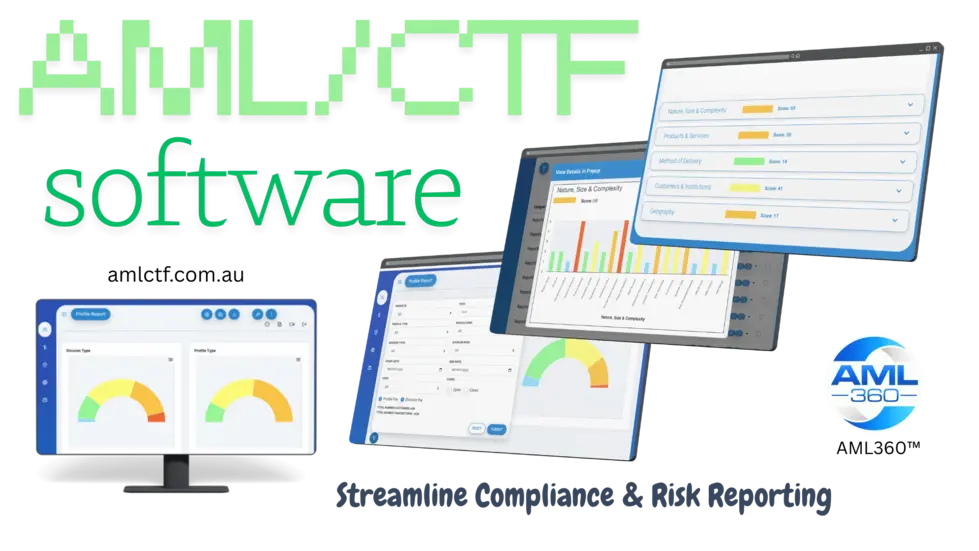
Why the AML/CTF Risk Assessment matters under the AML/CTF Act
What are the AML/CTF Risk Assessment Australia obligations under the AML/CTF Act? Experience a clear link to AUSTRAC’s expectations for efficient, effective compliance with AML360™. Experience a modern risk‑based digital compliance framework through a customised AML Digital Compliance Officer as a supporting internal compliance resource.
The AML/CTF Risk Assessment drives the AML/CTF Program
A compliant AML/CTF Program in Australia starts with a simple idea: you can’t control what you haven’t assessed. Under the Anti‑Money Laundering and Counter‑Terrorism Financing Act 2006 (Cth) (and associated AML/CTF Rules), reporting entities are expected to identify, assess, mitigate, and manage the money laundering and terrorism financing risks they face.
In practice, that means your AML/CTF Risk Assessment isn’t “nice to have” paperwork—it’s the engine that drives:
-
Customer Due Diligence
Risk profiling and ongoing monitoring.
-
Governance & Oversight
Keep managers and stakeholders informed.
-
Evidence-Based Compliance
Be audit ready.

AUSTRAC and “regulatory efficiency”: what good looks like
AUSTRAC’s supervision approach is increasingly shaped by a practical expectation: compliance should be effective, proportionate, and demonstrable—not performative.
“Regulatory efficiency” in this context translates into:
(a) Clear traceability from risk → control → outcome
(b) Consistent decisioning (same risk facts produce the same risk rating and treatment)
(c) Strong audit trails (who decided what, when, and why)
(d) Faster change management (new typologies, products, or threats reflected quickly)
(e) Reduced manual friction without reducing regulatory quality
In short: efficient compliance is defensible compliance—and defensible compliance is what survives scrutiny.
Core obligations of the AML/CTF Risk Assessment Australia (AML/CTF Act)
Think of the Risk Assessment as a “master control document” that informs how your program operates day to day.
Build and maintain an AML/CTF Program (risk-based)
Your program should be designed around your identified ML/TF risks and scaled to your business. Key expectations include:
(a) Governance and oversight (roles, responsibilities, escalation, board/senior management visibility)
(b) Risk controls (CDD/EDD, monitoring, screening where relevant, record-keeping)
(c) Ongoing customer due diligence (keeping customer risk current, not just at onboarding)
(d) Training tailored to roles
(e) Independent review at appropriate intervals and after material change

Conduct and document an AML/CTF Risk Assessment (and keep it current)
A robust risk assessment typically covers:
(a) Customer risk (types, behaviours, beneficial ownership complexity)
(b) Product/service risk (how offerings could be misused)
(c) Delivery channel risk (online, non-face-to-face, intermediaries, APIs)
(d) Geographic risk (jurisdictions of customers, counter-parties, operations)
(e) Transactional risk (speed, volume, patterns, velocity)
(f) Control effectiveness (how well your controls actually mitigate the risks)
It must be reviewed and updated when things change—new products, new channels, new partners, new geographies, or new typologies observed in your sector.
Apply customer due diligence (CDD) consistent with assessed risk
Your Risk Assessment should clearly inform:
– when you apply standard CDD,
– when you escalate to EDD (higher-risk customers, complex ownership, adverse information, etc.),
– how you verify identity and (where relevant) beneficial ownership, and
– how you manage ongoing due diligence for changes in risk over time.
Meet AUSTRAC AML/CTF Risk Assessment Australia Reporting Obligations
A risk-based program must connect to reporting workflows and evidence:
– Suspicious Matter Reports (SMRs) when suspicion thresholds are met
– Threshold Transaction Reports (TTRs) for cash transactions at/above the threshold
– International Funds Transfer Instruction (IFTI) reporting where applicable
– Record-keeping sufficient to demonstrate compliance and enable auditability.
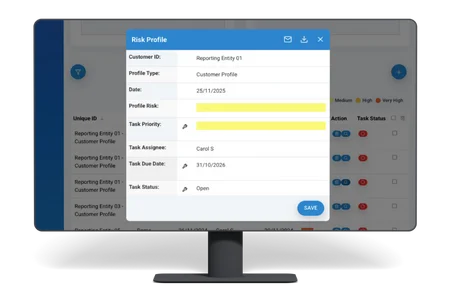
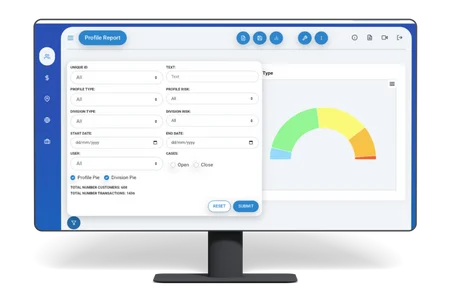
AML360™ provides a digital AML/CTF Risk Assessment Australia Report
Traditional AML programs often fail in one of two ways:
- they become static documents that drift away from how the business operates, or
- they become manual processes that can’t scale with growth, digital onboarding, or real-time payments.
AML360™ positions AML/CTF as an operational system: a digital framework that connects risk assessment, onboarding, monitoring, reporting, governance, and evidence into a single compliance “spine.”
What does an AML/CTF Risk Assessment Australia reporting framework look like?
A mature framework typically enables:
(a) Dynamic risk scoring (customer + product + channel + geography + behaviour)
(b) Control mapping (which controls mitigate which risks—and proof they ran)
(c) Typology-informed rules and scenarios (aligned to emerging threats)
(d) Case management workflows (from alerts → investigation → SMR decisioning)
(e) Evidence by design (audit trails baked into each compliance action).
A strong AML/CTF Risk Assessment under Australian law should be:
(i) Specific to your business model (not a template with your logo on it)
(ii) Operationally connected to CDD/EDD, monitoring, reporting, and training
(iii) Continuously updated as products, channels, and typologies evolve
(iv) Efficient and auditable, supporting AUSTRAC-facing assurance with less manual strain
AML360™ supports this direction by helping reporting entities move from static compliance to risk-based digital compliance—where every risk decision is traceable, every control has evidence, and every investigation has a consistent, reviewable workflow.
AUSTRAC: AML/CTF RIsk Assessment Australia