AMLCTF Risk Assessments

AMLCTF Risk Assessments → Automated, Structured Reporting

Move your AMLCTF risk assessments from unreliable workflows such as spreadsheets, email trails, and Word templates into a purpose-built digital workflow with AML360™ RegTech. AML360™ isn’t just a “tech upgrade”—it’s a practical way to reduce cost, improve accuracy, and produce clearer evidence for a genuine AUSTRAC-style risk-based approach.

MLTF Risk Report
  • Methodology

    A clear methodology for identifying and rating ML/TF risks must be logical and demonstrated.

  • Controls

    AML/CTF risk assessments must adequately inform the AML/CTF Program and align policies, procedures and controls to mitigate the risks.

  • Reporting

    Traceable decisions (who approved what, when, and why). Your firm must demonstrate governance systems for ongoing monitoring and reporting.

What changes when you digitise an AMLCTF Risk Assessment?

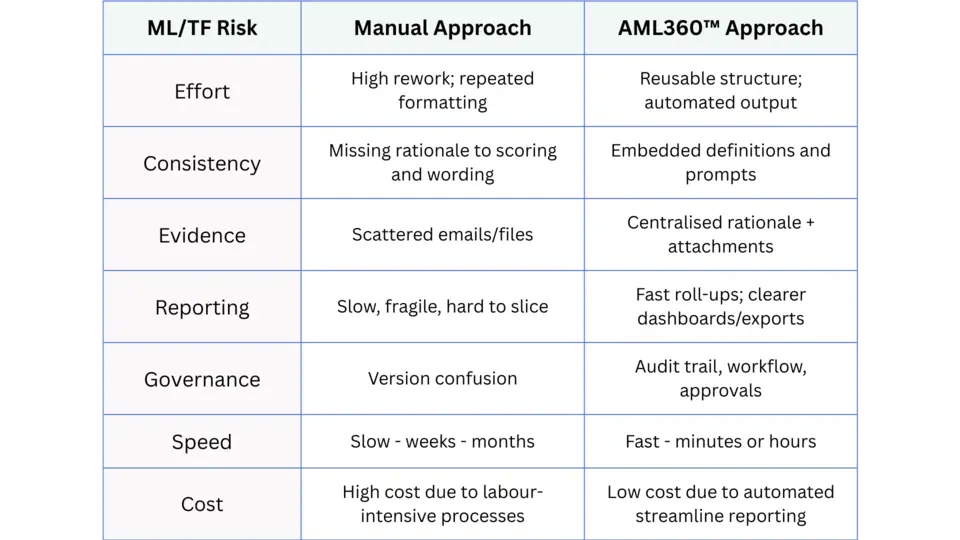
Manual processes tend to treat an AMLCTF Risk Assessment as a static document—rebuilt from scratch at review time, with inconsistent inputs and a lot of “best guess” scoring.

A digital approach treats AMLCTF risk assessments as a repeatable system. 

The Evolution of Regulatory Technology

The term “regulatory technology,” or “RegTech,” originated in 2015 when it was first used by the Financial Conduct Authority (FCA) in the UK. This marked the formal recognition of a growing sector that focuses on leveraging technology to enhance regulatory compliance and streamline various regulatory processes within the financial industry.

The conceptualisation of RegTech as a distinct advantage in managing regulatory obligations such as AMLCTF compliance gained further traction following the Covid pandemic. 

At this time the President of the Financial Action Task Force urged governments and businesses across the globe to adapt to changing global rise by adopting use of SupTech, FinTech and RegTech. 

The Financial Action Task Force Promotes Use of Regulatory Technology

The Financial Action Task Force (FATF) published a statement on June 24, 2020, addressing the impact of the COVID-19 pandemic. This statement urged governments and the business community to enhance their use of technology, specifically highlighting the importance of FinTech (financial technology), RegTech (regulatory technology), and SupTech (supervisory technology).

FATF emphasised that the pandemic had accelerated digital transformations, making it imperative for stakeholders to adapt quickly to the changing landscape. Former FATF President Liu stated adopting these advanced technologies, institutions can improve their compliance with anti-money laundering (AML) and counter-terrorism financing (CTF) obligations.

The statement acknowledged that leveraging these technologies could not only facilitate compliance but also ensure effective governance in a time when traditional methods may face disruptions due to the pandemic .

Furthermore, the FATF noted that enhancing the adoption of FinTech, RegTech, and SupTech could help mitigate the risks related to emerging vulnerabilities during the pandemic while continuing to uphold financial integrity. This was a part of the FATF’s wider initiative to promote a vulnerable economy’s resilience amid the evolving challenges posed by COVID-19 .

By encouraging this shift towards technological adoption, the FATF aimed to inspire a more robust response from the financial sector to the challenges brought about by the pandemic, ensuring that regulatory needs remain met even in times of crisis .

AML/CTF Outsourcing

Risk Heat Maps incorporated into AMLCTF risk assessments make risk obvious

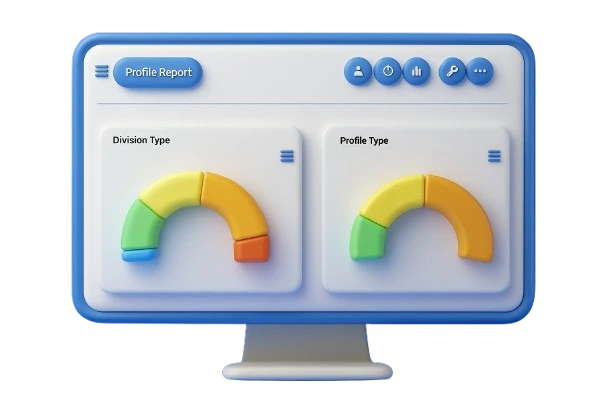
AML360™ additionally includes heat-maps to describe risks which can be downloaded to PDF, helping teams show risk concentrations clearly.

Why it matters: heat maps turn “we think…” into “here’s the risk distribution”—a fast route to management and board understanding.

AMLCTF Software Australia
AML360™ Australia

Advantages of moving to digital for the AMLCTF risk assessment lifecycle

Digitising your AML/CTF risk assessment pays off across the full lifecycle: build → review → approve → evidence → refresh.

1) Streamlined data capture → lower cost and faster refresh cycles

A well-designed digital approach reduces cost by:

(a) reusing structured inputs year-over-year,

(b) automating roll-ups (e.g., inherent → residual risk),

(c) generating board/committee-ready outputs without rework.

This is the “streamlined data reporting” advantage: less time assembling the story, more time improving the story.

2) Better governance: version control, accountability, and approvals

Digital platforms typically support:

(a) clear ownership per risk area,

(b) tracked changes,

(c) staged approvals and sign-offs,

(d) consistent review cadence.

That’s exactly what you want when demonstrating that the AMLCTF risk assessment is maintained and governed—not just written.

3) Digital AMLCTF risk assessments reduce subjectivity through explainable scoring logic

Digitisation helps reduce “risk guessing” by embedding:

(a) scoring definitions (likelihood/consequence),

(b) prompts aligned to common ML/TF risk dimensions (e.g., products, customers, channels, geographies),

(c) required rationale fields for key judgements.

The output becomes more defendable because the method is consistent.

4) Constructive reporting that supports AUSTRAC’s risk-based approach

AUSTRAC’s guidance focuses on understanding ML/TF risk so that controls are proportionate. Digital reporting supports this by making it easier to produce:

(a) heat maps and risk summaries that link to drivers,

(b) action plans tied to specific risk treatments,

(c) evidence that your AML/CTF Program settings match assessed risk (not generic controls).

In practice, “constructive reporting” means a regulator (or auditor) can follow the line from risk → assessment → control → residual risk → improvement plan without detective work.

About AML/CTF Australia
ML/TF Customer Risk Ratings

About AML360™ RegTech

The evolution of AML360™ has roots that predate 2015 when the term “regulatory technology” or “RegTech” was first used by the UK Financial Conduct Authority.

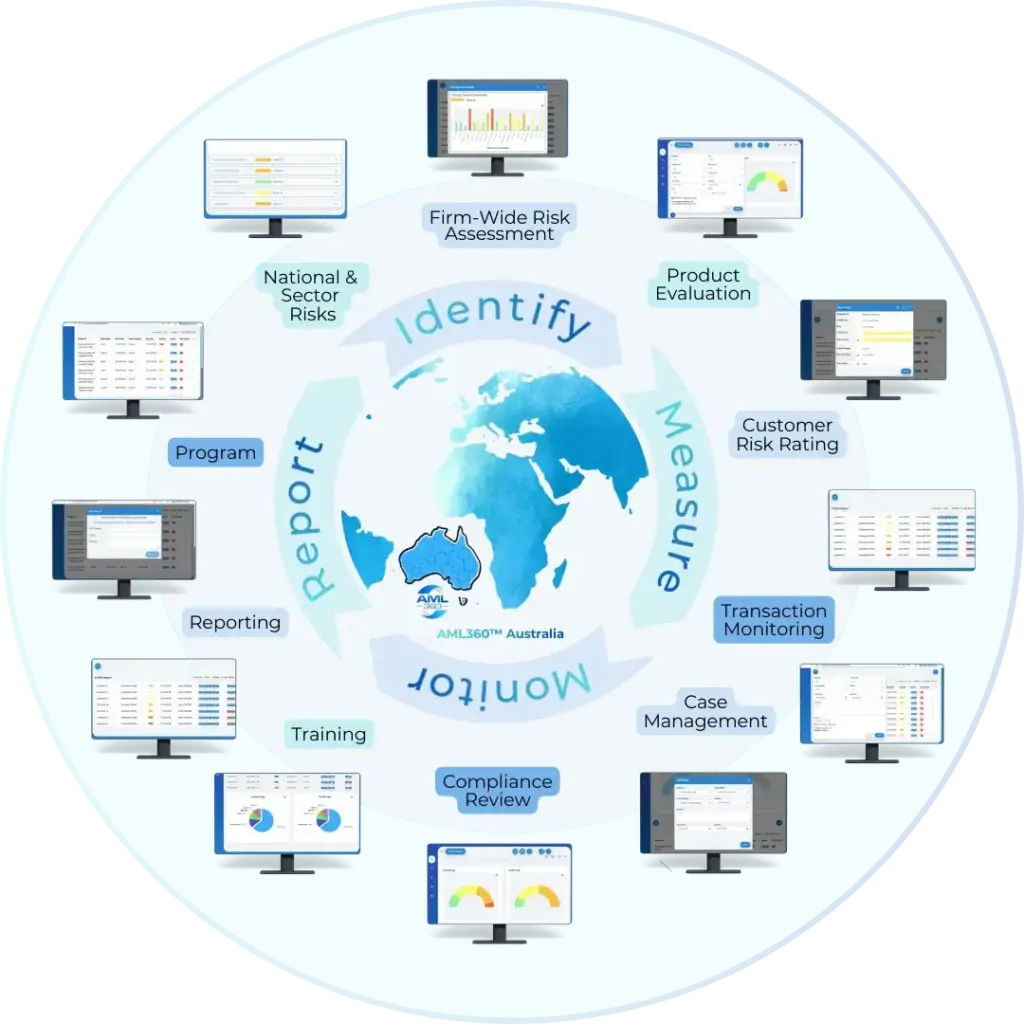
With development of AML360™ technology commencing in 2013 and gradually expanding over the years, the technology compliance solution now caters as an end-to-end AMLCTF solution.

→ Business Risk Assessments

→ Standalone business reporting

→ Group wide reporting

→ Client Risk Profiling

→ Activity monitoring

→ Internal Review Checks

→ Management Reporting

→ Geography Risks

→ Case Management

Though AML360™ does not provide identity verification screening, it does offer the option of an API “Plug-In”. This enables your firm to select your preferred identity verification provider (single or multiple). When the screening checks are complete, the results are automatically fed into your AML360™ Australia platform. The customer’s name is removed and replaced with a Unique ID.  This ensures only your business knows who the screening results and risk rating refers to. 

Updates of existing client risk ratings are automated.  

Using the AML360™ API your business can select your preferred country source for identity verification screening.

By automating MLTF compliance reporting,  AML360™ RegTech simplifies the compliance burdens faced by financial institutions, allowing them to navigate regulatory requirements more efficiently and effectively

AML360™ uses a reliable risk-methodology, following the principles and guidelines set by the International Organisation for Standardisation as set out in ISO-31000 (principles, framework and processes for managing risk).

AML360™ operates to provide a scoring logic that is transparent and reviewable. Updates or changes to scoring can be done instantly.

The AML360™ RegTech solution becomes a by-product of your AML/CTF Program – not a separate project or separate solution to your AML/CTF Program.

AML360™ aligns with AUSTRAC’s expectation that reporting entities identify, assess, and understand ML/TF risk, and keep the assessment current and documented in a way that supports risk-based controls (see AUSTRAC guidance.

The hidden costs of manual AMLCTF risk assessments

Manual doesn’t just mean “slower.” It usually means higher operational risk and messy governance.

1) Eliminate labour-intensive AMLCTF risk assessments

Manual AMLCTF risk assessment maintenance often involves:

(a) copying and pasting between versions;

(b)chasing stakeholders for inputs;

(c) reconciling conflicting data;

(d) recreating heat-maps, tables, and board packs;

That’s expensive time spent formatting—rather than improving controls. AML360™ removes all that noise and delivers customised regulatory reporting, with a simple ‘Click & Go’ interface.

2) Don’t “guess” AMLCTF risk assessments

When the methodology lives in someone’s head (or a spreadsheet cell comment), teams tend to:

(a) apply inconsistent likelihood/consequence definitions;

(b) over-weight or under-weight certain risk factors;

(c) struggle to explain “why” a score changed.

Digitising forces clarity: AML360™ definitions, weightings, and rationale is explainable and embedded into AML/CTF compliance workflows and written reports.

3) Reporting bottlenecks (and fragile audit trails)

Manual reporting usually creates:

(a) long lead times to produce management reports,

(b) limited ability to slice results by product/channel/customer type;

(c) Weak evidence trails when AUSTRAC (or auditors) ask “show me how you got here.”

AML360™ digital workflows help produce constructive reporting—the kind that shows not only ratings, but drivers, control coverage, and actions.

ML/TF risk-based

Why AMLCTF risk assessments matter for Australian businesses (including Tranche 2 readiness)

As Australia’s AML/CTF regime evolves (including the expansion commonly discussed as “Tranche 2”), more businesses will need to stand up or mature an amlctf risk assessment capability that is: (i) repeatable, (ii) scalable across products and services, (iii)easy to evidence and refresh.

AML:CTF Risk Reporting

If your obligation footprint grows, manual methods don’t scale gracefully—they multiply workload and inconsistency. AML360™  scales by design and modifies to regulatory changes and AUSTRAC updates.


About AML360™ Australia AMLCTF Risk Assessments

The AML360™ digital AML/CTF risk assessment helps your firm in many ways to keep on top of AML/CTF compliance obligations.  The AML360™ Australia platform is designed for simplicity and compliance efficiency. Benefits of AML360™ include:

– remove labour-intensive processes (less formatting, less chasing inputs),

– reduce guessing of risks (consistent scoring + documented rationale),

– reduce costs through streamlined data reporting (faster refresh, easier roll-ups),

– produce constructive reporting aligned to AUSTRAC’s risk-based expectations (risk-to-control traceability).

When done well, digitisation doesn’t just make compliance easier—it makes the risk assessment more useful as a management tool, which is exactly where AUSTRAC wants it: informing controls, resources, and decision-making.