Easily Transition to a Risk-Based AML/CTF Program
AML/CTF Program: Transition to a digital and automated risk-based operational framework. Get confident that your business is meeting reforms under Australia's AML/CTF laws.
AUSTRAC Reforms Require a Risk-Based AML/CTF Program
Australia’s AML/CTF Supervisor is AUSTRAC. AUSTRAC is the acronym for Australia Transaction Reports and Analysis Centre.
AUSTRAC operates as Australia’s financial intelligence unit and anti-money laundering and counter-terrorism financing (AML/CTF) regulator.
Commonly referred to as the ‘AML/CTF Supervisor‘, AUSTRAC assists businesses to meet their obligations to combat threats arising from money laundering (ML) and terrorism financing (TF). This includes the underlying criminal activity that precedes these ML/TF offences.
AUSTRAC’s enforcement powers allow it to compel compliance with anti-money laundering and counter-terrorism financing (AML/CTF) laws. Enforcement actions include issuing infringement notices, remedial directions (requiring specific fixes), and accepting binding enforceable undertakings. AUSTRAC can also seek injunctions and civil penalty orders in the Federal Court, and refer matters for criminal prosecution.
Commencing from 31 March 2026, AUSTRAC’s AML/CTF Supervisory model is transitioning to risk-based
Tranche 2 Entities Begin ML/TF Supervision from 1 July 2026
A new group of captured business entities, referred to as ‘Tranche 2 Entities’, begin ML/TF supervision from 1 July 2026. Registration with AUSTRAC can commence from 31 March 2026 with mandatory enrolment by 29 July 2026.
This extensive reform under Australia’s AML/CTF laws will see professional business services such as lawyers, accountants, real estate agents, and conveyancers, being captured when providing certain ‘designated services’.
Referred to as ‘Tranche 2 Entities’, AUSTRAC reforms are bringing these business entities into Australia’s Anti-Money Laundering (AML) and Counter-Terrorism Financing (CTF) rules and compliance obligations.
Tranche 2 entities must be ready to operate with a risk-managed AML/CTF Program from 1 July 2026.
Money Laundering/Terrorism Financing Assessments
AML360™ Regulatory Technology (AML360™ RegTech) enables small businesses to meet regulatory expectation with Australia laws for combating money laundering/terrorism financing.
Starting with a ‘Money Laundering/Terrorism Financing’ risk assessment, your business discovers the type of inherent vulnerabilities or inherent risks that must be managed and detailed in the AML/CTF Program.
AML360™ wraps risk management, policy, procedures and controls into one unified AML/CTF Program.


AUSTRAC’s reforms, commencing for existing entities from 1 March 2026, emphasise the need for ML/TF entities to have operate and maintain ML/TF risk assessments, including having in place comprehensive policies and controls.
The 2026 ML/TF reforms also have a focus on businesses establishing stronger governance systems, with adequately appointed ML/TF compliance officers. Demonstration of governance controls includes better reporting of ongoing risks and the ML/TF risk status. These reforms require business entities to ensure they have developed and updated programs that address their ML/TF risks.
How Can AML360™ Assist with your AML/CTF Program?
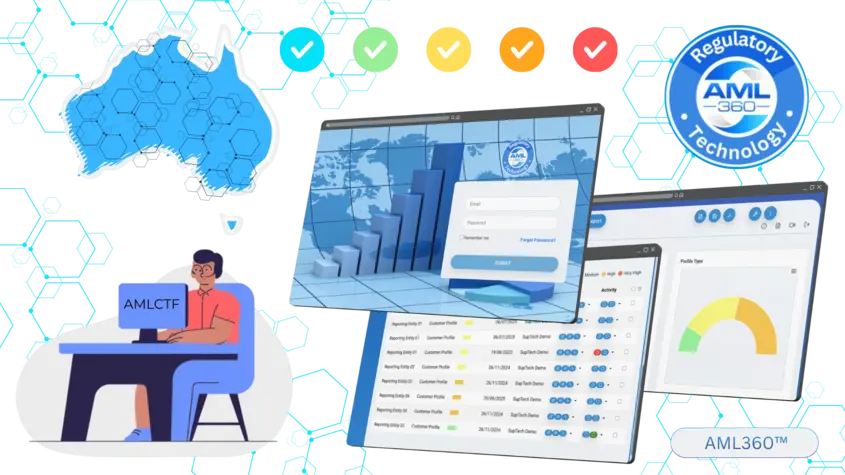
AML360™ is a comprehensive system of interconnected AML/CTF functions, delivered as a ‘Point & Click’ user interface. Offered as a unified ML/TF compliance framework, or individual ML/TF compliance modules, AML360™ can handle everything from the initial AML/CTF risk assessment to ongoing risk-based reporting.
By utilising AML/CTF technology solutions as the ‘back office’ function, businesses can place their valued human resources where they are needed most.
AML360™ technology takes care of the subject matter expertise and eliminates labour-intensive processes. Remove repetitive administrative processes and replace them with automated risk analysis. Achieve ongoing monitoring and reporting with a ‘Click and Point’ function. Download to PDF or manage your AML/CTF risk register through a secure Cloud account.
AML360™ is developed to assist ML/TF reporting entities to avoid high ML/TF compliance costs, whilst achieving ML/TF compliance efficiency.
Don’t make the mistake of relying too heavily on human resourcing for repetitive administrative processes. Think smarter and demonstrate governance with the AML360™ compliance and risk management platform.
AML360™ offers packages to fit every size budget from small, medium and large-sized enterprises.
Select a single AML/CTF compliance module or multiple AML/CTF modules.





About AML/CTF Program Reforms
If your business is captured under Australia’s Anti-Money Laundering and Counter-Terrorism Financing laws, you must have an AML/CTF program implemented before your business begins providing designated services.
‘Designated Services’ are listed at Section 6 of the AML/CTF Act 2006 with the ‘captured’ activity described in a series of tables.
Examples of the types of activities currently captured under the AML/CTF Act includes financial services, remittance payments or transfers, managing digital values (digital assets and cryptocurrency), buying and selling precious metals over a prescribed threshold and other regulated services. The full list of the types of ‘designated services’ captured can be viewed at the Australasian Legal Information Institution.
1. What is an AML/CTF Program?
An AML/CTF program is a written plan that explains:
how your organisation identifies risks of money laundering or terrorism financing,
the controls you use to reduce those risks, and
how you manage and monitor ongoing compliance.
These programs protect your organisation, your customers, and the wider community by helping to prevent financial crime.
2. Why an AML/CTF Program Matters
The AML/CTF Program is an organisation’s defence mechanism to guard against various risks arising from ML/TF. These risks include legal, financial and reputation risks.
If an AML/CTF Program is not operating effectively, then the business is at a higher level of facing regulatory risk.
An AML/CTF Program must focus on real risks that your business could face — it isn’t just a checklist. A strong AML/CTF program will show how the firm understands is ML/TF risk exposure and how it will remain compliance with its legal obligations.
A well-developed and operating AML/CTF Program will build trust with business stakeholders who provide your organisation a service. A strong AML/CFT Program will also assist to build a proactive relationship with your AML/CTF Supervisor.
When developing and updating an AML/CFT Program, it is important that it be tailored to the nature, size and complexity of business services.
Sector and national risks must be incorporated to reflect the ML/TF landscape as reported by AUSTRAC.
3. What’s in an AML/CTF Program?
Your AML/CTF programme must clearly explain the policies, procedures, and controls your business uses to incorporate a risk-based approach to meeting its ML/TF compliance obligations under Australia’s AML/CTF laws.
Your entity’s ML/TF risk-based approach should be documented to describe its governance controls to (a) Assess and understand ML/TF risk, (b) Mitigate and manage risk on an ongoing basis, and (c) Meet all relevant AML/CTF legal requirements.
An entity’s risk-based approach should set out how it manages risks linked to customers, products and services, and country risks (to name a few).
No two AML/CTF programs are identical. ML/TF reporting entities must ensure the AML/CTF program it operates under is aligned to the nature, size, structure and risk profile of the business.
4. Core AML/CTF Controls
ML/TF RISK ASSESSMENT: When updating AML/CTF Programs, your business should focus on how it identifies, manages and reduces ML/TF risk. It must include a documented assessment of ML/TF risk and describe the triggers that warn or initiate an update. The AML/CTF Program should include a minimum frequency for reviews, regardless of triggers.
ML/TF GOVERNANCE OVERSIGHT: Your organisation must set out the internal approval procedures for implementation and updates of an AML/CTF Program. AML/CTF governance oversight includes systems relied on that can demonstrate ongoing oversight from the board or senior management.
AML/CTF COMPLIANCE OFFICER: AUSTRAC requires an AML/CTF Compliance Officer to be at a management level. This means they have authority and responsibility for ensuring compliance, but not necessarily a ‘senior manager’ role within the organisation.
EMPLOYEE CHECKS: The AML/CTF Program must set out how the organisation applies due diligence on staff to reduce internal risk. Staff who have responsibilities under the AML/CTF program must also receive AML/CTF training.
ML/TF SYSTEMS AND CONTROLS: Tools and processes must exist that enable reporting and ongoing monitoring. This includes checking the status of the organisation’s AML/CTF Program (strengths and weaknesses), as well as monitoring and reporting of captured activity.
ONGOING DUE DILIGENCE: ML/TF reporting entities must be able to demonstrate the processes that keep customer information up-to-date and how it applies a customer risk-rating model. Assessing customer risks assists in identifying those clients requiring enhanced checks or further due diligence.
AML/CTF INDEPENDENT REVIEW: An AML/CTF program must be independently reviewed periodically, with results of the review reported to senior management.